


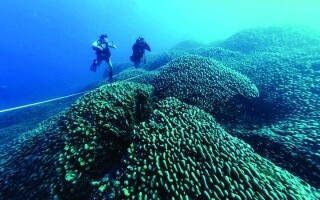
Astronomers announced yesterday that they discovered the largest coral reef in the world off the coast of the Solomon Islands in the Pacific Ocean, a significant finding that 'breathes life and color'. This massive coral is so large that researchers, who dove into the crystal-clear waters of the Solomon Archipelago, initially thought they had stumbled upon the remains of a giant coral.
Marine ecology scientist Enric Sala noted: 'Although we believed there was nothing left to discover on Planet Earth, we found a massive coral that houses over a billion tiny polyps, breathing life and color.' Researchers indicate that the coral has been growing for over 300 years and consists of a 'complex network' of small reefs, differing from coral reefs that consist of various and numerous colonies of corals.
The research team reported that the 'giant coral', measuring 34 meters wide and 32 meters long, is three times larger than the previous record-holding coral known as 'Big Mama', located in American Samoa. Chief scientist Molly Timmerman stated: 'At that time, the 'Big Mama' resembles a giant (bottle) pulled over a coral reef, while the newly discovered coral looks like a piece (of a bottle) beginning to melt and spreading across the ocean floor', and this coral is longer than a blue whale, and is considered 'transitionally enormous', which can be seen 'from space'.
The coral was discovered at the southeastern end of the Solomon Islands in an area known as 'Three Sisters', by a National Geographic team during a scientific expedition in this region. The official representative of the Solomon Islands, Colin Pick, stated: 'There is still much we can learn about the abundance of marine life and ocean ecosystems, but this discovery opens doors to knowledge.' He added: 'We need to continue scientific research to better understand our biological diversity and our planet.'